The Solo Strategist: Mastering the One-Man Design Team
Senior Value
Being a one-man design team is a paradox: you have the most creative freedom, yet you’re often the loneliest person in the room. Whether in a startup, a consultancy, or in-house, the toughest part isn't the design itself—it’s advocating for it when there are no formal requirements. When the 'what' and 'how' are left entirely to you, your value is defined by the goals you set for yourself. These are the strategies for gaining trust and delivering impact that I wish I had known when I first started navigating the solo path.
I. The Risk:
The Invisible Leak: How Solo Designers Lose Their Seat at the Table.
In a one-man team, power is not a given; it is a discipline. If you do not own the design strategy, the team will subconsciously redistribute your decision-making power to whoever provides the requirements. The lack of a Design Lead or VP of Design means there is no "structural" shield for your authority. If you aren't careful, your strategic power is distributed among other departments by default.
The "Order Taker" Trap:
If you wait for requirements to be handed to you by Product or Engineering, you’ve already surrendered your power. You become a "resource" rather than a "partner," and design becomes the final coat of paint instead of the foundation.
Design by Committee:
In the absence of a strong solo advocate, stakeholders from non-design backgrounds (Sales, Marketing, Dev) begin to make UX decisions based on personal preference. This dilutes the product vision and erodes the designer’s professional standing.
The Hand-off Vacuum:
Without a strategic approach to how you hand off work, you lose control of the implementation. If you simply "toss the Figma file over the wall," the power to interpret your designs shifts entirely to Engineering, often resulting in compromised user experiences because the "why" was lost in transit.
The Documentation Debt:
Senior value is maintained through the logic behind the pixels. If you don't document the strategy, you leave your decisions open to being "overruled" by whoever has the loudest voice in the room.
II. The Opportunity:
The Strategic Mediator — Using Design Thinking as a Shield
Albert Einstein once said, "In the middle of every difficulty lies opportunity." For a solo designer, the "difficulty" is often being squeezed between aggressive business goals and rigid technical constraints. But within that friction lies your greatest opportunity: becoming the objective mediator.
In my experience working across startups and high-complexity sectors, I’ve learned that the loneliest place to be is defending a design based solely on "best practices." When you are the only designer, your opinion is easily outvoted by a louder stakeholder or a shorter development deadline.
To survive, you have to move the conversation from "The designer wants this" to "The user needs this."
By introducing Design Thinking workshops and Lean User Research, you aren't just adding more tasks to your plate—you are building a "Neutral Ground." This framework forces Business and Tech teams to step out of their silos and look at the user. You stop being the person who "draws" and start being the person who "decides" by facilitating a shared truth.
When the user’s needs are clearly mapped out on a whiteboard, you don’t have to be the one saying "No" to feature creep or technical shortcuts. The data says it for you. This is the ultimate solo designer strategy: protecting your professional authority by becoming a facilitator of logic rather than just a person with an opinion.
III. How to Win
Tactical Execution: How to Win the Room
Strategy is useless without execution. To win as a solo designer, you must prove that design isn't a "bottleneck"—it’s a catalyst for speed. In my time designing for Private Banking, I realized early on that nobody has an hour to "brainstorm." I had to learn how to draw a common ground in minutes, not days.
Winning isn't about having the loudest voice; it’s about having the most efficient process. Here is the solo designer’s tactical playbook for converting skeptics into partners.
The 5-Minute Objective Filter: Lessons from Private Banking
In a high-stakes environment like Fintech or Banking, stakeholders often enter meetings with conflicting priorities. I started implementing a "5-Minute Objective Filter" at the start of every kickoff. By forcing the CTO and Product Manager to align on the one primary goal before a single pixel is drawn, I saved weeks of re-work.
Senior Tip: If they can’t agree on the goal in five minutes, they won’t agree on the design in five weeks. Stop the meeting there—you’ve already saved the company money.
Lean User Research: The Solo Designer’s "High-Signal" Playbook
You don’t need a research lab or a recruitment agency to be data-driven. When you are a team of one, the goal isn't "perfection"—it’s de-risking. Here is how to get user insights for $0 in under 2 hours:
1. The "Internal Proxy" Interview (15 Mins)
If you can’t reach external customers immediately, go to the people who talk to them every day.
HOW:
Book 15 minutes with a Customer Support Lead or a Sales Rep.The Prompt:
Ask, "What are the top 3 things users complain about regarding [Feature X]?" or "What is the one question you get asked every single day?"The Win:
You get a year’s worth of aggregated user pain points in a single coffee break.
2. The 5-Second Test for Visual Hierarchy
Before committing to a high-fidelity prototype, test if your layout actually communicates the "Business Goal."
HOW:
Use a tool like UsabilityHub (or just hop on a quick Zoom call with someone outside the project). Show the screen for exactly 5 seconds, then hide it.The Question:
"What was the main purpose of that page, and what is the one thing you would click next?"The Win:
If they can't answer, your UI is too cluttered. You now have objective proof to push back on "making the logo bigger" or adding extra buttons.
3. "Hallway" Guerrilla Testing
This is the fastest way to validate a flow before hand-off.
HOW:
Grab a colleague from a different department (Marketing or HR—people not involved in the product logic). Hand them your phone with a Figma prototype.The Prompt:
Give them a specific task: "Show me how you would send $500 to a friend using this app." Watch where they click and where they hesitate. Do not help them.The Win:
Seeing a fresh pair of eyes struggle with a "simple" button is the most humbling (and convincing) evidence you can show a stakeholder.
4. The "Recorded Evidence" Library
A solo designer’s opinion is just an opinion, but a video of a user failing is a fact.
HOW:
Use a screen recorder during your sessions. Clip 30-second "highlight reels" of users struggling.The Win:
Instead of arguing with a PM about a feature, you simply drop a 30-second video into the Slack channel. The video does the advocating for you.
Conclusion: Own the Gap
Being a "one-man design team" is a test of leadership, not just technical skill. The difficulty of the role is exactly where your power lies. When there is no one else to set the goal or define the process, you have the unique opportunity to design the department you’ve always wanted to work in.
By identifying the Risks of passive hand-offs, positioning yourself as the Strategic Mediator through design thinking, and executing with Lean Tactics, you stop being a production resource. You become the core architect of the product’s success.
Don't wait for permission to be senior. Start by acting as the "CEO of Design" for the space you occupy today.
Next Reading:
Leveling up your Seniority:
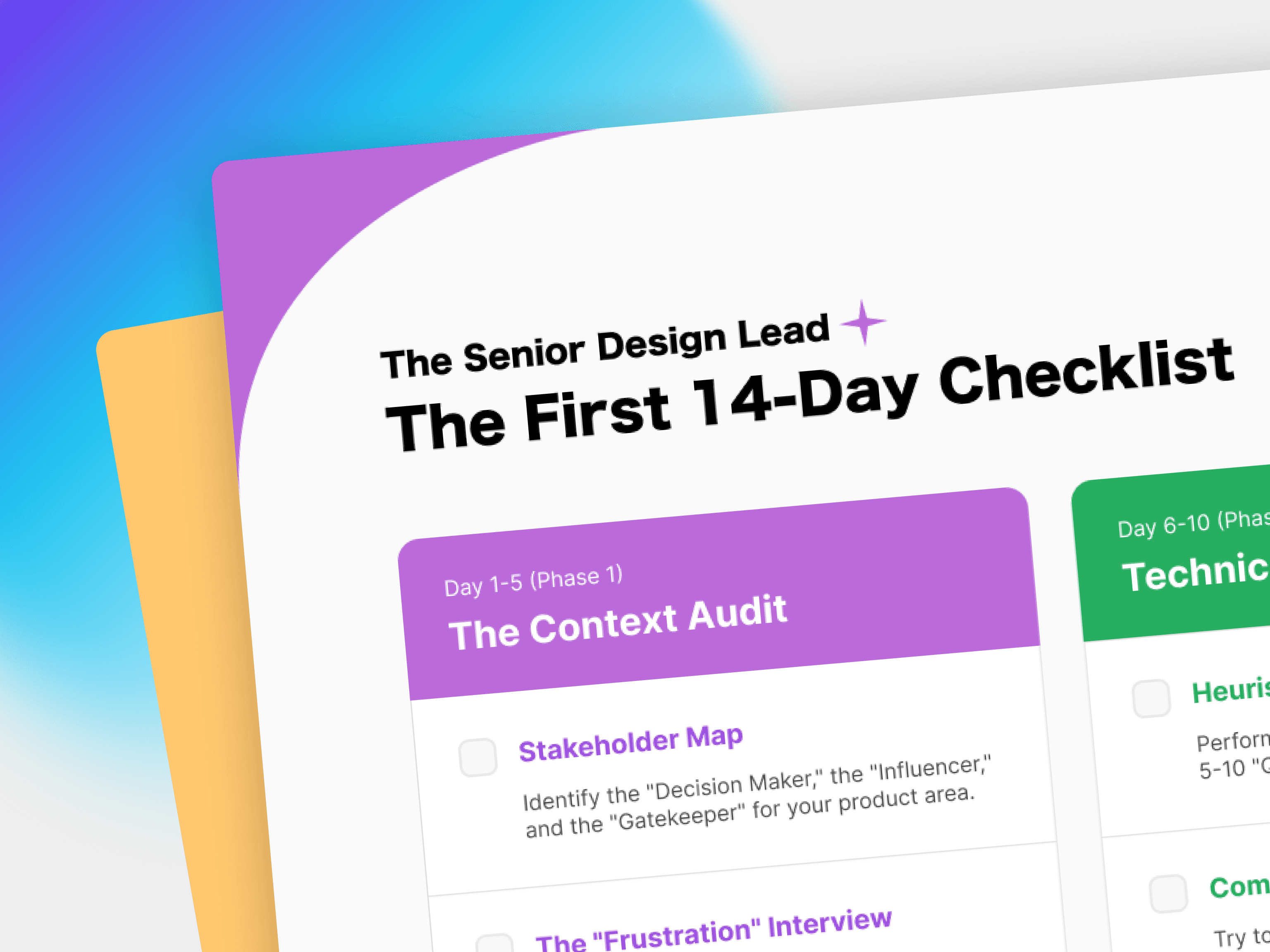
Landing the role is only Phase 1. As a solo designer, your biggest challenge isn't the pixels—it's the precedent you set on Day 1. If you spend your first two weeks just "making things pretty," you’ve already handed over your strategic power. Check out my First 14-Day Senior Onboarding Checklist to see how to audit design debt and map stakeholder expectations before the "quick requests" start rolling in.