From Junior to Senior Product Designer: 3 Mindset Shifts for a Winning Portfolio
Portfolio

Stop Being a "Designer" and Start Being a "Partner"
Your portfolio is not an art gallery; it’s a business case. Whether you’re a 10-year Advertising veteran pivoting into Product, a Graphic Designer tired of "making things pretty," or a Junior UI/UX Designer stuck in the "pixel-pushing" phase—the hurdle to reaching a Senior role is the same. It’s not about mastering a new Figma plugin. It’s about changing your vocabulary.
Most designers fail to move up because they focus on the outputs (the screens, the colors, the icons). But Senior leaders are hired for their outcomes. To land a Senior role, you have to stop showing people what you made and start showing them how you thought. You need to move from being the person who "executes the brief" to the person who "solves the business problem."
Here are the three fundamental shifts you need to make to stop being seen as a Junior and start being treated as a Product Leader.
Swift 1. Lead with the "Problem," Not the "Pixels"
A Junior starts their case study with a beautiful UI shot. A Senior starts with a messy business challenge. To bridge the gap, you need to show that you can take a vague business complaint and turn it into a searchable, solvable design objective.
The Strategy: Framing with "How Might We" Instead of saying "I was told to build a checkout page," a Senior designer uses the HMW framework to align the team. This shifts the focus from a feature to a human-centric solution.
The Junior Way: Showing off a 10-screen flow and explaining the color palette.
The Senior Way: Defining the Business Friction through a strategic lens.
Bad: "We need a new dashboard."
Good: "How might we redesign the dashboard to reduce the user’s time-to-task by 20%, so they feel successful within their first 30 seconds?"
The Pro Tip: Highlight your Constraints. Talk about the tight deadlines, technical debt, or budget limits you had to navigate. Showing how you solved your "How Might We" despite these hurdles is what proves you’re a veteran.
Senior Secret: By starting your case study with a HMW statement, you immediately tell the recruiter: "I don't just push pixels; I define the mission."
The "How Might We" (HMW) Translation by Role
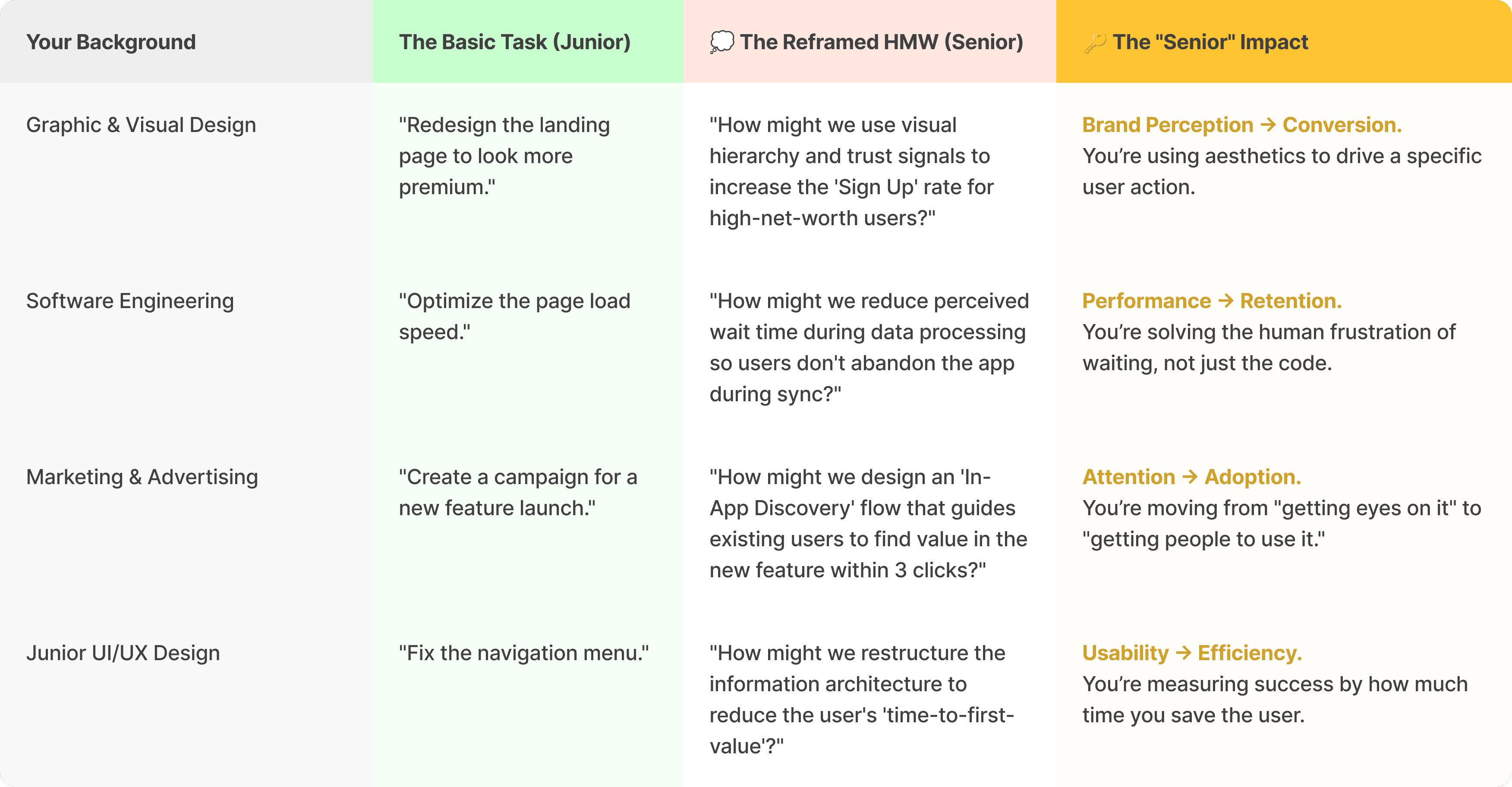
Why this "HMW" shift matters for your Portfolio:
When you use this language, you are telling the hiring manager: "I understand that my work exists to serve a business goal."
For the Graphic Designer: It proves you aren't just "decorating."
For the Engineer: It proves you understand the "User Experience" beyond the "Technical Stack."
For the Ad Creative: It proves you understand "Service" beyond "Persuasion."
Pro-Tip for your Case Study:
Don't just hide this HMW statement in the middle of your text. Make it the header of your project. > Project Title: Fintech App Redesign > The Mission: How might we simplify cross-border payments for freelancers to reduce transaction errors by 25%?
This immediately frames you as a Strategist before they even look at your first wireframe.
Swift 2: The Messy Middle: Why your "Failure" is a Senior-Level Asset
Most portfolios are "Art Galleries"—they show perfect, polished final results. But in the real world, product design is a series of pivots. A Senior portfolio doesn't hide the "ugly" phase; it celebrates the Validation Phase.
The Star of the Show: The "Mini-User Test"
The biggest differentiator between a Junior and a Senior is Ego. A Junior falls in love with their first idea. A Senior tries to break it as fast as possible.
The Magic Number 5
In the validation phase, the user’s voice is your most powerful tool—but it doesn't have to be expensive. You don’t need a high-tech lab or a five-figure budget to extract meaningful insights; you just need the 85% Rule. Citing the Nielsen Norman Group, testing with just 5 users is often the 'sweet spot' that uncovers 85% of your core usability issues, allowing you to iterate with confidence without draining resources.
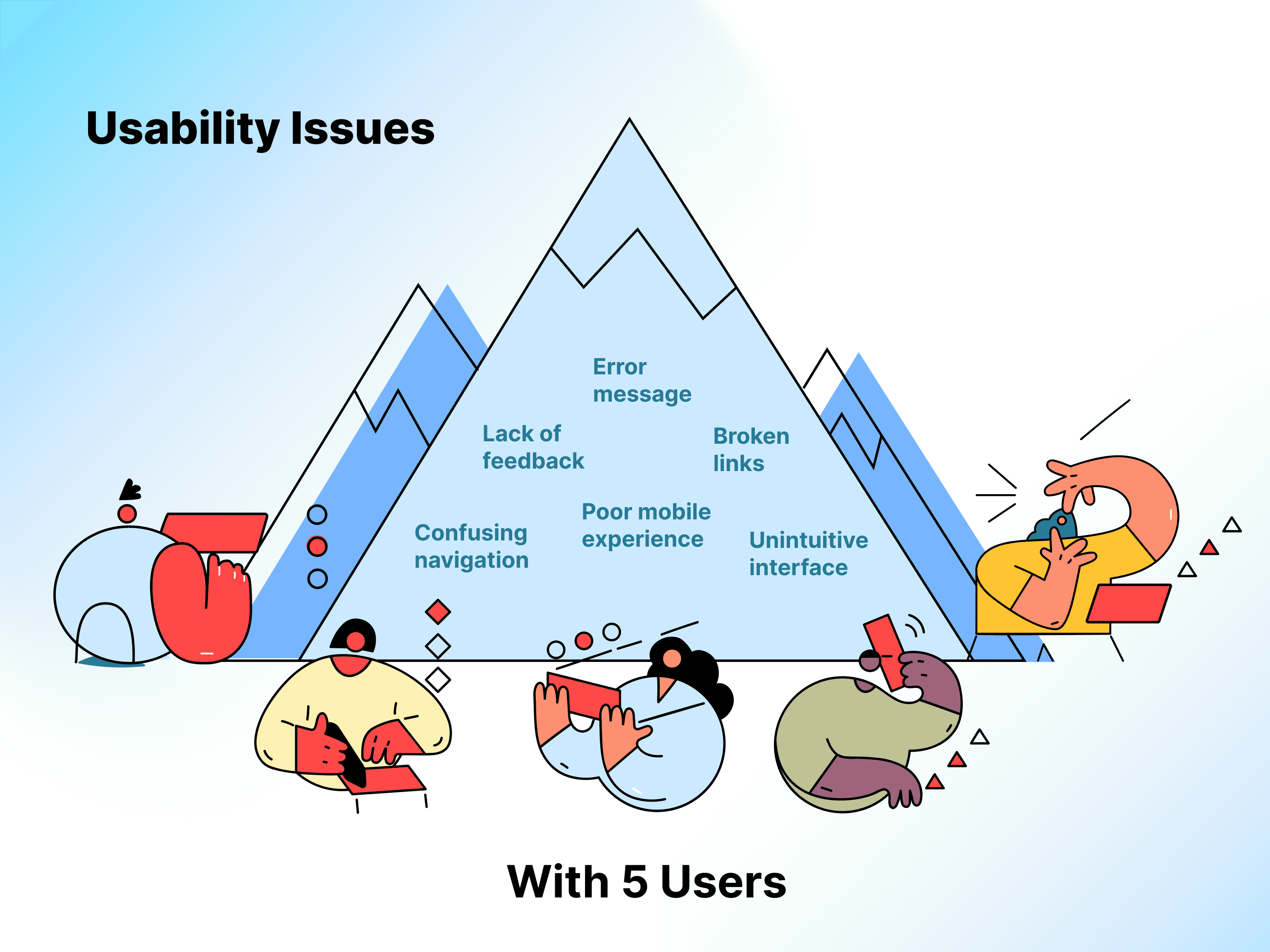
The "A-ha!" Moment: When the Data Surprises You
The 'A-ha!' moment happens when user data challenges your assumptions. Instead of just documenting a linear process, a Senior designer uses these testing results to validate the transition from a rough draft to an optimized solution. The real star of your portfolio is the Pivot Point—the specific moment in the 'Messy Middle' where the data spoke louder than your intuition and forced a strategic design change.
The Junior Way: "I designed this button because it looked modern, and users liked it." (Purely subjective).
The Senior Way: "I initially designed a 5-step onboarding flow. However, after a Guerilla Test with 5 users, I found that 80% of them abandoned the app at step two because they felt overwhelmed by the data entry. I pivoted to a 'Single-Field' entry, and completion rates skyrocketed."
Pro tip: How to Show the "Messy Middle" in Your Portfolio:
The "Ugly" Prototype: Post a screenshot of your mid-fidelity wireframe.
The Feedback Loop: Add a call-out box: "User #3 said: 'I don't know where to click next.' This was a pattern for 3 out of 5 testers."
The Resulting Pivot: Show the final design next to it and explain: "Based on this 'Surprising' insight, I removed the secondary navigation to focus the user on the primary CTA."
Why the "Messy Middle" Wins Every Time
When a hiring manager sees a "Surprising Data Result" in your work, they stop worrying about whether you can use Figma. Instead, they start trusting you to manage a product. * It shows Humility: You can put your ego aside for the sake of the user.
It shows Efficiency: You know how to do "Zero-Budget" testing (Coffee shop tests, hallway tests) to get results fast.
It shows Logic: Every pixel in your final design now has a "Why" backed by a "Who."
The Senior Audit:
Does your portfolio have a section titled "What I learned during testing"? If not, you’re missing the chance to show off your most valuable skill: The ability to turn a 'Messy' insight into a 'Clean' solution.
Swift 3: Sell the "So What?" (Data-Driven Storytelling)
Whether you're coming from Advertising or Graphic Design, you already know how to tell a story. Now, you need to learn how to tell it with data. A Senior Designer must prove that their work actually moved the needle.
Quantify Your Wins: Don’t just say "I improved the UX." Say, "By redesigning the onboarding flow, we boosted conversion by 15% and cut support tickets by 20%." * Stakeholder Management: Describe how you aligned the PM and the Engineering team. The most compelling part of a Senior case study is often the story of how you balanced user needs with business goals.
"But what if I don’t have real data?"
One of the biggest anxieties for career-switchers or designers working on internal tools is the lack of "Big Data" like a 20% increase in sales. If you don't have a dashboard full of metrics, you have to lean into Qualitative Impact and Proxy Metrics.
As a Senior, you can prove impact by highlighting how you moved the needle in these three areas:
1. Impact on Velocity (Efficiency)
If you can’t prove you made the company money, prove you saved them time. * The Graphic/Ad Pivot: Instead of "I made a beautiful layout," say: "I created a modular design system that allowed the team to build landing pages 3x faster." * The Logic: Time is money. Increasing a team's speed is a massive Senior-level win.
2. Impact on Risk (Mitigation)
Sometimes the "So What?" is about what didn't happen—like a disastrous launch or a confusing user flow.
The Strategy: Use your Mini-User Test results here.
The Narrative: "By identifying a major navigation flaw during the wireframe stage, I prevented a potential 50% drop-off rate at launch. We caught the 'fire' before it started."
3. Impact on Alignment (Stakeholder Buy-in)
A Senior’s job is often to get everyone on the same page.
The Narrative: "I used a 'How Might We' workshop to align the Engineering and Marketing teams on a single vision. This reduced 'scope creep' and ensured the MVP was delivered two weeks ahead of schedule."
The "Simulated" Result (For Self-Projects)
If your project is purely for your portfolio, you can still show a data-driven mindset by defining Success Metrics.
Don't say: "The project was a success."
Do say: "The success of this feature would be measured by a 15% reduction in support tickets regarding password resets and a 10% increase in daily active users."
Senior Secret: Hiring managers care more that you know which metrics matter than the actual number itself. Identifying the North Star Metric shows you understand the business.
Pro-Tip: Use "Proxy Metrics"
If you can't get a percentage, use a Ratio or a Comparison.
Instead of "20% more efficient," say "3x faster."
Instead of "15% more signups," say "Reduced the signup process from 5 steps to 2."
Senior Secret: Recruiters look for these numbers because they show Accountability. Even if the number is small (e.g., "5% increase"), it shows that you designed with a goal in mind, rather than just "making it look better."
Closing: From Designer to Product Leader
The difference between a Junior and a Senior isn't the number of years on your resume; it’s the level of ownership in your portfolio. You have the skills and the intuition—now you just need to show the strategy. Stop asking for permission to be a Senior and start presenting yourself like one.
Use this final audit to ensure your next case study doesn't just show "what you made," but proves why you matter.
The Senior Portfolio Checklist
Check these off before you hit "Publish" on your next case study:
☑️ The Business "Why": Did you lead with a clear business problem or a "How Might We" statement instead of just a feature list?
☑️ The 85% Rule: Did you document a Mini-User Test with at least 5 people?
☑️ The Honest Pivot: Did you show one "Messy Middle" iteration that failed and explain the surprising data that forced you to change course?
☑️ The "So What?" Metric: Even if you don't have live data, did you define the Success Metrics (Efficiency, Conversion, or Risk) you were aiming for?
☑️ The Stakeholder Story: Did you mention a technical or business constraint and how you navigated it with your team?
☑️ The Edge Case Audit: Did you include at least one screen showing an "Unhappy Path" (error states, empty states, or slow loading)?
Leveling up your Seniority:
A winning portfolio gets you the interview, but showing you can think like a strategist wins the job. If you’re ready to move beyond 'pixel-pushing' in your case studies, read my guide on Moving from Order-Taker to Senior UX Strategist.