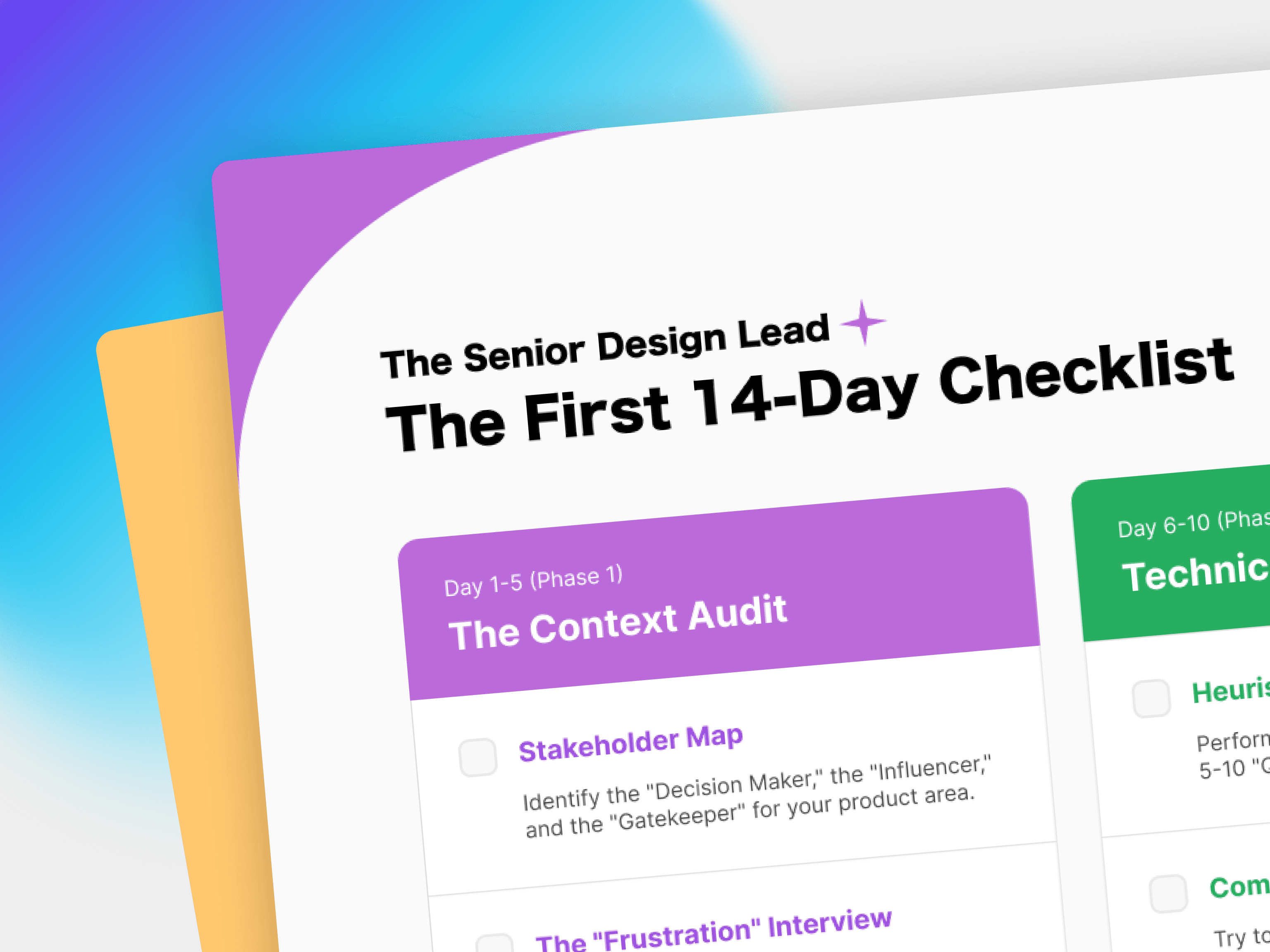
The Low-Maintenance Designer: Mastering the PM Mindset for High-Impact Product Growth
Senior Value

"Have you ever opened a Jira ticket, stared at a one-sentence brief from your PM, and felt that immediate wave of frustration?
It’s easy to complain about 'unclear requirements' or 'lack of direction.' But in a competitive market, the designers who thrive are the ones who stop waiting for the perfect brief and start creating it.
Hiring managers aren't just looking for someone who can execute a vision; they are looking for 'low-maintenance, high-impact' partners—designers who reduce the team's cognitive load by thinking three steps ahead.
By adopting a PM Mindset, you stop being an order-taker and start being a force multiplier. In this deep-dive, we’re going to explore how mastering self-management and strategic thinking can turn your stakeholders' ambiguity into your greatest opportunity for leadership and impact."
The PM Mindset: Defining Success Before Pixels
When a stakeholder hands you a vague request like "We need an onboarding flow," the standard designer response is to wait for more details. The high-impact designer knows that ambiguity is an invitation to lead.
Instead of asking "What should this look like?", adopt a PM mindset and ask questions that define the Business ROI:
The "North Star" Metric: "What specific behavior change are we looking for? Are we trying to increase Day-1 retention or reduce the time-to-first-value?"
The Constraints Audit: "What are the technical or time limitations for this V1? Are we building a 'quick-win' MVP or the long-term vision?"
The User Success Definition: "If a user finishes this flow, what is the one thing they must feel or know?"
Why this makes you "Low-Maintenance": You aren't just taking orders; you are helping your PM tighten the product requirements. By extracting these goals early, you prevent "pivot-pain" later in the design process.
The PM Mindset: Risk Assessment & Market Positioning
Once the goals are set, the urge is to jump straight into Figma. Resist it. A PM-minded designer "steps back" to understand the Product Ecosystem.
Competitive Intelligence:
Don't just look at "pretty" UI patterns. Analyze how competitors use onboarding as a growth lever. Are they front-loading data collection or using a "freemium" hook?Technical Feasibility Sync:
Spend 15 minutes with an engineer. Understand the "gravity" of the data you’re working with. A PM mindset means knowing that a "perfect" design that takes 3 months to build is often a failure compared to a "good" design that launches in 2 weeks.The Journey Audit:
Map the "Before" and "After." Where is the user coming from (e.g., a marketing ad or a referral)? Where do they go next?
The PM Mindset: Iterative Validation & Stakeholder Alignment
The final pillar is about communication, not just craft. Use Low-Fidelity (Lo-Fi) wireframes as a strategic tool to align the team on logic before anyone gets distracted by colors or fonts.
The "Strawman" Strategy:
Present a low-fi flow as a hypothesis. Tell your stakeholders: "This is the logic of the user journey based on our success metrics. Let’s break the flow here before we spend time on high-fidelity."Focusing on Information Architecture:
Lo-fi forces the PM and stakeholders to focus on conversion points and friction. It answers the question: "Does this sequence of information lead the user to the goal we defined in Pillar 1?"Speed as a Skill:
Delivering a lo-fi validation within 48 hours of a vague brief is a massive "high-impact" signal. It proves you can move the needle forward without needing a 20-page PRD.
Closing: From Moving Pixels to Moving Metrics
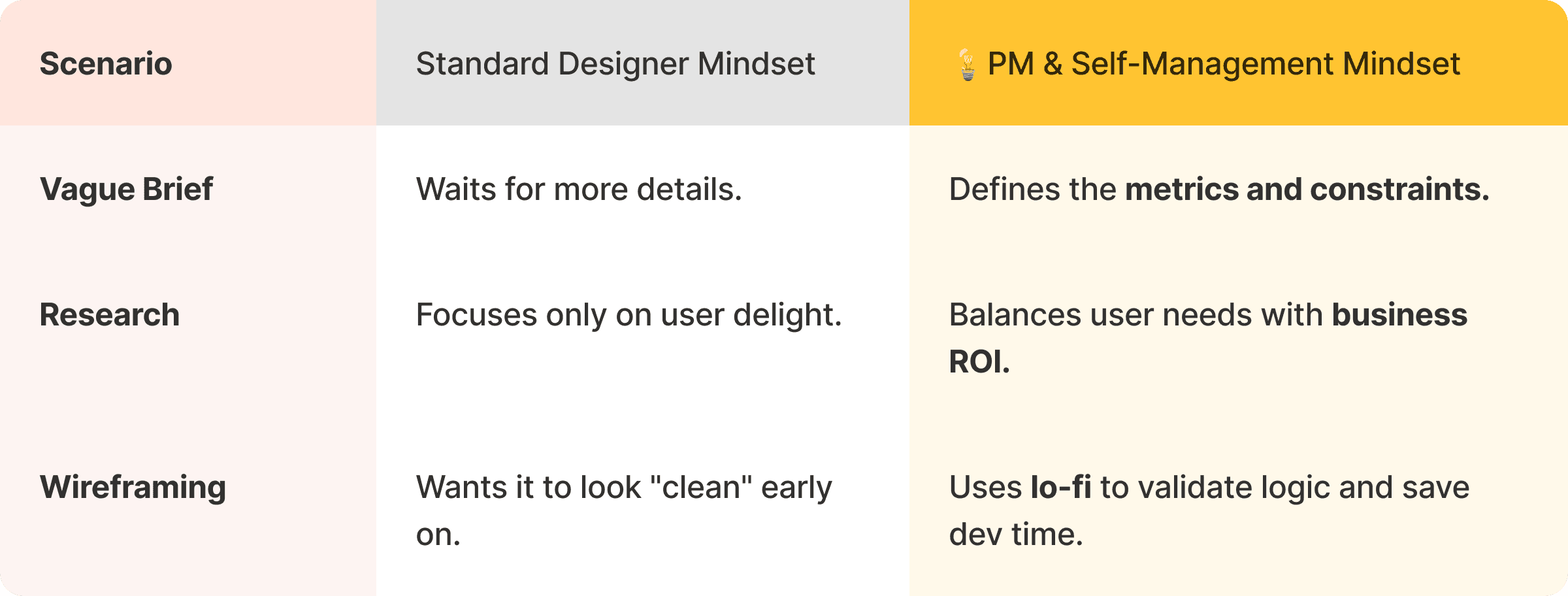
Cheat sheet of shifting the designer mindset to PM & Self-management mindset
Adapting a PM mindset doesn’t mean you’re doing someone else’s job; it means you’re doing yours at a Staff level.
By mastering these three pillars—Strategic Extraction, Contextual Deconstruction, and Logic-First Validation—you transform from a designer who waits for instructions into a leader who creates clarity.
When you stop complaining about a vague brief and start engineering the solution, you provide massive relief to your product partners. You become the "low-maintenance, high-impact" designer that every recruiter is hunting for: the one who doesn't just deliver beautiful screens, but drives the product forward.
The next time you see an unclear Jira ticket, don't roll your eyes. See it as your next opportunity to lead.
Enjoyed this deep-dive into the PM mindset? > If you’re ready to take your strategic influence even further, check out my guide on "How to Move from Order-Taker to Senior UX Strategist." It’s the perfect companion piece to help you fully transition from executing tasks to leading product vision.